The 30-second answer
Cook mushrooms before you freeze them. Sauté them in a wide pan until the water has cooked off and the edges brown, cool them completely, freeze them in a single layer on a tray, then bag them flat. They keep 2 to 3 months with good texture and cook straight from frozen. Freezing mushrooms raw is the common shortcut and it is the reason so many people think frozen mushrooms are watery — raw mushrooms are roughly 90 percent water, and freezing that water is what wrecks them.
The rule
Freeze cooked mushrooms, not raw ones. The pan removes the water that the freezer would otherwise turn against you.
Why raw mushrooms freeze badly
Water expands as it freezes. Inside a raw mushroom that water sits in intact cells, so the ice crystals puncture the cell walls from the inside out. Nothing puts those walls back — when the mushroom thaws, it slumps and leaks the water it was holding, and you get a grey, limp piece that steams instead of browning.
Cooking first drives off most of that water before it can do the damage, which is why a sautéed mushroom comes out of the freezer as recognisably a mushroom and a raw one comes out as a wet sponge. This is also why you should never refreeze mushrooms that have thawed: the second round of ice crystals works on tissue that has already been broken once.
Four ways to freeze, compared
All four start with clean, dry, evenly cut mushrooms. The difference is how much work you do now versus how much texture you have later.
| Method | Prep time | Keeps well | Texture after cooking | Best for |
|---|---|---|---|---|
| Sautéed | 15–20 min | 2–3 months | Best — browned and firm | Almost everything; the default |
| Steam-blanched | 10–15 min | 3–4 months | Soft but intact | Large batches, freezer efficiency |
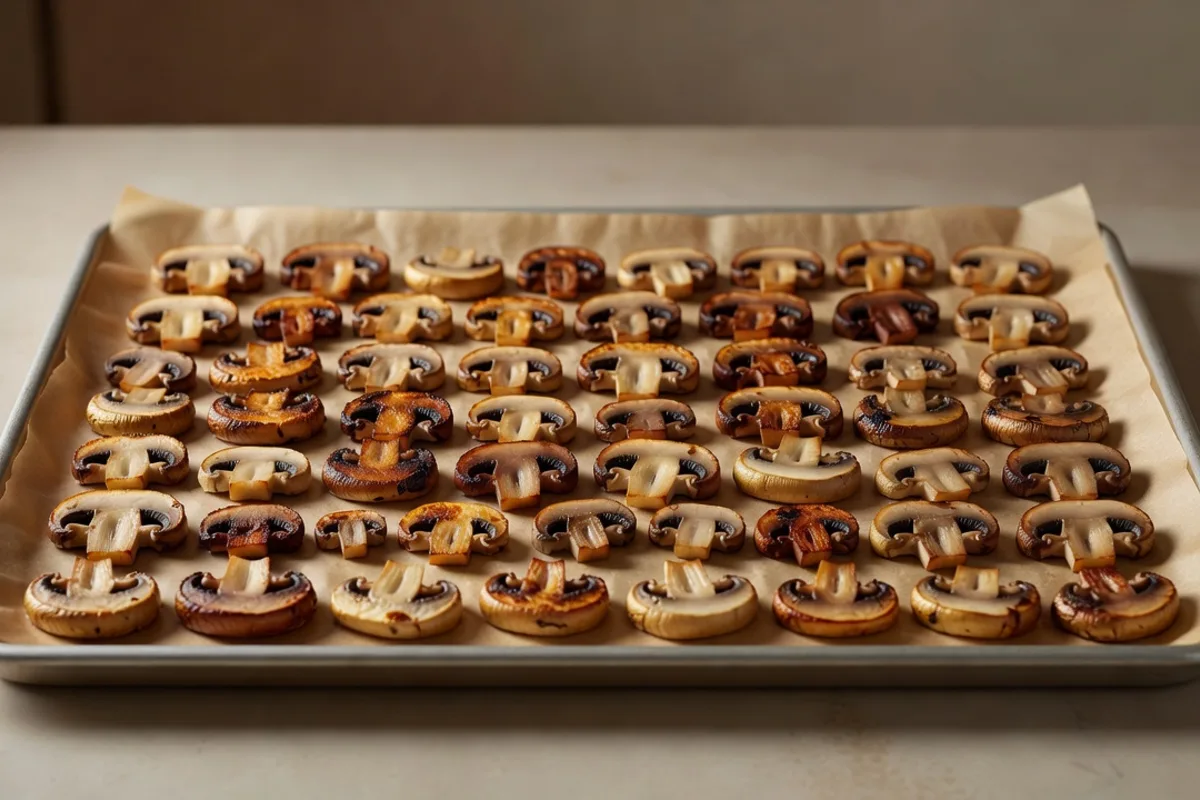
| Roasted | 25–30 min | 2–3 months | Concentrated, slightly chewy | Sheet-pan volume with no stirring |
| Raw, sliced | 5 min | 1–2 months | Watery and limp | Soups and stocks only |
| Duxelles (cooked paste) | 30–40 min | 3 months | Excellent — it was already a paste | Sauces, fillings, stuffed anything |
The sauté method, in detail
This is the one to use unless you have a reason not to. Work in batches wide enough that the mushrooms sit mostly flat — a crowded pan steams, and steamed mushrooms carry their water into the freezer with them. Use a little oil rather than butter, because butter solidifies oddly when frozen and browns again unevenly on reheating.
Stop when the pan looks dry and the edges are properly browned, not merely softened: any liquid still in the pan is liquid that becomes ice. Skip the garlic, herbs, wine, and cream — aromatics fade or turn bitter over months, and dairy splits on thawing. Season those in when you cook the mushrooms for the dish they are actually going into.
The steam-blanch method, for volume
Blanching is how commercial packers do it, and it is worth knowing if you have bought several pounds cheap. Steam the pieces over boiling water for 3 to 5 minutes depending on thickness, until they are heated through and slightly translucent, then plunge them into ice water to stop the cooking and drain them thoroughly. Steaming beats boiling here because boiled mushrooms absorb water rather than losing it.
Blanched mushrooms keep a month or so longer than sautéed ones, because the brief cooking deactivates the enzymes that dull flavour over time, but they come out softer and without any browning. They are best where they will be simmered anyway.
When freezing raw is actually fine
There is one honest use for raw frozen mushrooms: anything that ends up in liquid and cooks for a long time. Stock, broth, a long-simmered soup, a bolognese. In those dishes the texture was never going to survive anyway, and the flavour transfers fine.
If you are doing it, slice the mushrooms first, freeze them in a single layer, bag them, and use them within a month or two — and cook them straight from frozen, without thawing. Shiitake stems and mushroom trimmings are the best candidates of all, since a scrap bag in the freezer becomes stock later at no cost.
Portion flat, portion small
How you bag mushrooms matters nearly as much as how you cook them. A flat bag freezes through in a fraction of the time a lumpy one takes, which means smaller ice crystals and less damage, and it thaws evenly and stacks like a file. Press out as much air as you can — air is what causes freezer burn, the dry greyish patches that taste of nothing.
Then portion for the way you actually cook: roughly a cup per bag covers a pasta sauce or a risotto, and it is far easier to use two bags than to hack a portion off a frozen block.
How long they really keep
Food held constantly at 0°F / -18°C stays safe indefinitely — freezing does not make food unsafe, it just stops the clock. What runs out is quality. Sautéed mushrooms hold their texture and flavour for about 2 to 3 months, blanched ones 3 to 4, and raw ones 1 to 2 before they turn noticeably watery and flat. Past those windows they are still perfectly edible and simply less good, so use the older bags in stews and soups where nobody is examining the texture. A freezer that gets opened constantly, or one that defrost-cycles, shortens all of these numbers.
Which mushrooms freeze best
- Button, cremini, portobello: freeze very well sautéed. The workhorses of this method.
- Shiitake, maitake, king oyster: dense enough to hold their structure; among the best results you will get.
- Porcini, morels, black trumpets (market-purchased or expert-verified): freeze well cooked, though drying suits them even better if you want the flavour concentrated.
- Chanterelles: dry-sauté them first, exactly as you would to cook them, then freeze. Raw-frozen chanterelles turn to mush.
- Oyster and shimeji: acceptable but not exciting — the thin edges go limp. Send them to soups.
- Enoki and lion's mane: skip it. Both are too delicate to come back from freezing in any useful state.
- Wood ear: no reason to bother. It is sold dried and rehydrates perfectly, which is a better route.
What not to do
- Do not thaw before cooking. Frozen mushrooms go straight into a hot dry pan; thawed ones leak onto the board and go limp.
- Do not refreeze anything that has thawed. Texture collapses and the food-safety margin narrows.
- Do not freeze in the shop carton. It is vented on purpose, which is the opposite of what a freezer needs.
- Do not salt heavily before freezing. Salt pulls water out and lowers the freezing point, both of which work against you here.
- Do not freeze mushrooms that were already on the edge. The freezer pauses spoilage, it does not reverse it — a mushroom that smelled sour going in smells sour coming out.
Cooking them afterwards
Take them straight from the freezer into a hot, dry pan and let the ice water boil off before you add fat — the same sequence as fresh mushrooms, just with more water to drive away at the start. Expect them to be softer than fresh no matter how carefully you froze them, and put them where that does not matter: soups, sauces, gravies, risotto, fillings, pizza. Our guide to cooking frozen mushrooms walks through the pan sequence in detail, including the reasons thawing makes it worse.
Fast method
- Clean and cut the mushrooms as you would for cooking: quarter small ones, slice large ones about 1/4 inch thick. Keep the pieces even so they cook at the same rate.
- Sauté them in a wide pan over medium-high heat with a little oil, in batches if the pan is crowded. Cook until the released liquid has evaporated and the edges are browned, about 8 to 10 minutes.
- Season lightly or not at all. Salt draws out more water in the freezer, and you can season properly when you cook the mushrooms for real.
- Cool them completely on a plate or tray. Freezing anything warm builds ice crystals inside the bag and raises the temperature of everything around it.
- Freeze in a single layer on a lined tray for about an hour, until firm. This keeps the pieces separate so you can pour out a handful instead of chiselling at a block.
- Bag them flat, press the air out, label with the date, and stack. Flat bags freeze faster, thaw faster, and store better than lumpy ones.
Small fixes that matter
- Freeze in the portions you actually cook with. A 1-cup bag goes into a pan or a soup; a 2-pound brick has to be defrosted as a whole before you can use any of it.
- Undercook slightly if the mushrooms are destined for a long-simmered dish. They will finish cooking in the pot.
- Squeeze the air out by hand, or lower a nearly-sealed bag into a bowl of water so the pressure pushes the air out through the last inch of the seal.
- Label the variety as well as the date. Frozen cooked mushrooms all look alike, and porcini deserve better than being mistaken for button mushrooms.
Storage and reheating
- Sautéed: cooled completely, frozen flat in 1-cup portions, 2 to 3 months for best quality.
- Blanched: drained thoroughly, bagged flat, 3 to 4 months.
- Raw: sliced and single-layer frozen, 1 to 2 months, for soup and stock only.
- All of them: cook from frozen, never thaw, and never refreeze once thawed.
Frequently asked questions
Can you freeze mushrooms raw?
You can, but they thaw watery and limp because ice crystals rupture the cell walls of a food that is about 90 percent water. Raw freezing only makes sense for mushrooms headed into stock, soup, or a long-simmered sauce, and they should be used within a month or two.
Do you have to cook mushrooms before freezing?
For any dish where texture matters, yes. Sautéing drives off most of the water before it can freeze into cell-puncturing crystals, which is the whole reason cooked mushrooms come back from the freezer and raw ones do not.
How long do frozen mushrooms last?
Sautéed mushrooms hold good texture for 2 to 3 months, blanched for 3 to 4, raw for 1 to 2. At a constant 0°F they stay safe far longer than that — what expires is quality, not safety.
Should you thaw frozen mushrooms before cooking?
No. Cook them straight from frozen in a hot dry pan and let the ice water boil off first. Thawing lets them leak their water and go limp before they reach any heat.
Can you freeze mushrooms whole?
You can, but there is rarely a reason to. Whole mushrooms freeze slowly, which means larger ice crystals and worse texture, and they still have to be cut once frozen. Cut them before cooking instead.
Why did my frozen mushrooms turn out slimy?
Usually one of three things: they were frozen raw, they were thawed before cooking, or the pan never got hot enough to drive off the ice water. Cook from frozen in a wide, hot, dry pan and wait for the sizzling to replace the bubbling.
Can you refreeze mushrooms?
No. The first freeze already broke the cell structure and the thaw released the water; a second cycle leaves you with pulp, and the time spent above freezing narrows the safety margin as well.
Is it better to freeze or dry mushrooms?
It depends on the mushroom. Dense, aromatic varieties like porcini, shiitake, and morels concentrate beautifully when dried and store for a year. Everyday button and cremini mushrooms are better sautéed and frozen, since drying them gains little.
Good with
soups, pasta sauces, gravy, risotto, stews, fillings.
Related guides
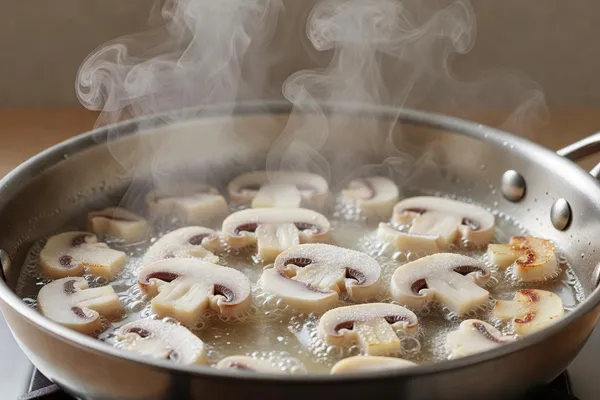 5 minHow to cook frozen mushrooms without thawingCook frozen mushrooms straight from the freezer in a hot dry pan. Skip the thaw, drive off the ice water, then brown and season at the end.
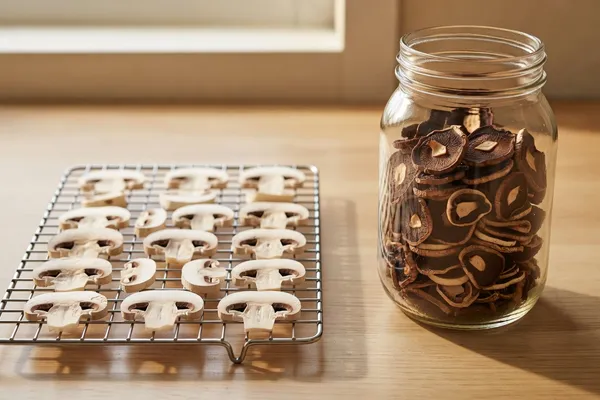 7 minHow to dry mushrooms in a dehydrator or ovenDry mushrooms at 125–135°F until they snap rather than bend — 4 to 10 hours in a dehydrator, 2 to 4 in an oven. Slicing, conditioning, and storage.
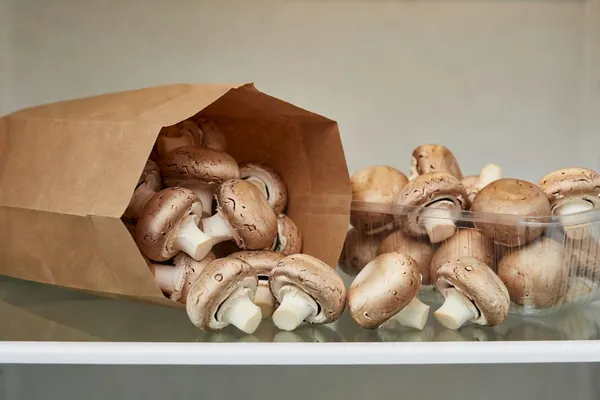 6 minHow to store mushrooms so they stay firmStore mushrooms unwashed in their vented carton or a paper bag on a main fridge shelf, never sealed plastic. Shelf life by variety and when to cook them.
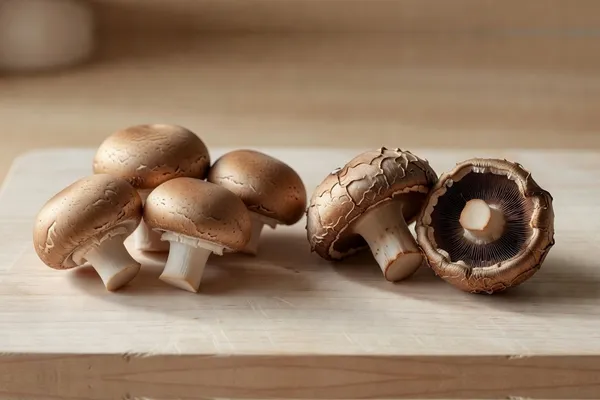 6 minHow to tell if mushrooms are badMushrooms have gone bad when they feel slimy, smell sour or fishy, or grow fuzzy mold. Wrinkles and dark caps are usually still fine to cook.
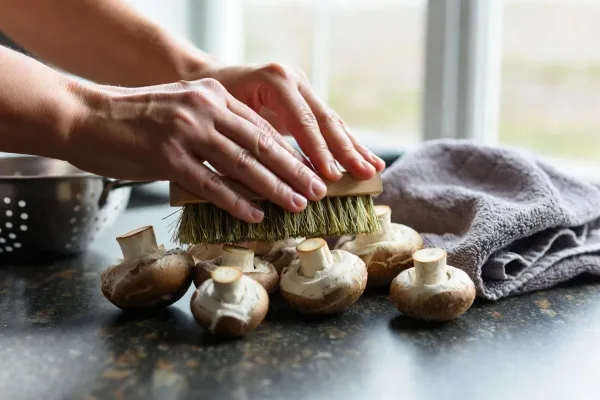 4 minHow to clean mushrooms before cookingClean mushrooms with a brush, damp towel, or a quick rinse—never a soak. What to use for each variety so they brown instead of steam.
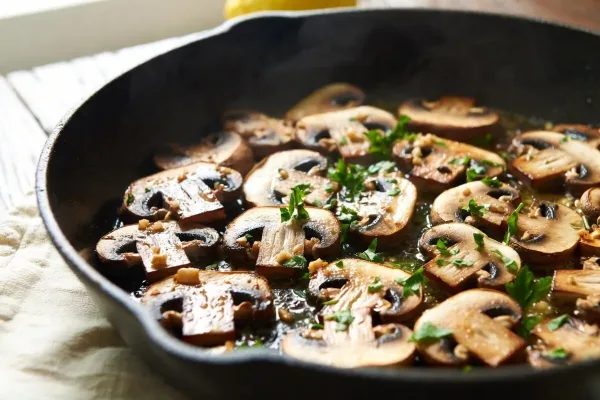 6 minHow to cook mushrooms in a panCook mushrooms in a hot pan until browned and juicy, with simple timing for tender centers, crisp edges, and a savory finish.
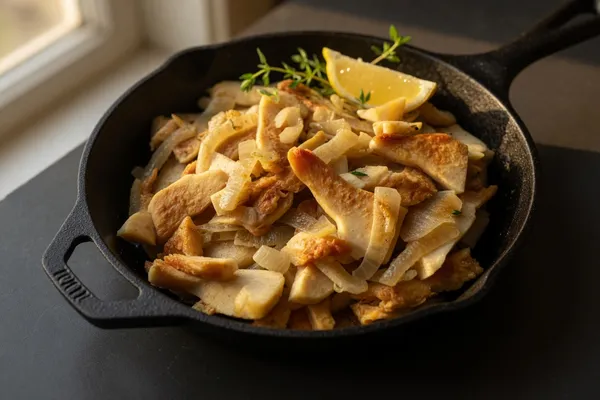 8 minHow to cook chicken of the woodsChicken of the woods needs longer cooking than most mushrooms — 15 to 20 minutes. Use the young tender growth, slice across the grain, and cook it through.